

Computational Modeling of Retrograde (Vakri) Motion and Ceṣṭā-bala in Parāśarī Jyotiṣa: An Astronomical Formalization and Knowledge-Engineering Treatment
Pranav Anand¹ and Anand Vadakepat¹
¹ RetroGrade, Jothishi Online and Advertising Services Pvt. Ltd., Bengaluru, India
Correspondence: research@retrograde.co.in · https://retrograde.co.in
Abstract
Retrograde (vakri) motion is one of the most interpretively significant — and most frequently misapplied — constructs in Vedic astrology, yet consumer astrology software typically reduces it to a boolean flag. This paper gives a precise, reproducible treatment. We (i) formalize apparent retrograde motion in the geocentric ecliptic frame, deriving the station condition and the synodic timing of the retrograde arc for the classical grahas; (ii) formalize the classical quantification of motional strength — ceṣṭā-bala — within Parāśara's ṣaḍbala scheme, and relate it to the eight-fold gati taxonomy; (iii) present algorithms that determine retrograde state and compute ceṣṭā-bala directly from an ephemeris; and (iv) describe how these primitives are operationalized within a knowledge-grounded, multi-agent question-answering system (RetroGrade). We are explicit about scope: the scientific claims of this work concern the correctness of astronomical computation and the faithful, auditable operationalization of documented classical rules. We make no empirical claim regarding the predictive validity of astrological interpretation itself. The contribution is therefore one of computational modeling, reproducibility, and knowledge engineering.
Keywords: Vedic astrology; retrograde motion; vakri; ceṣṭā-bala; ṣaḍbala; gati; computational Jyotiṣa; ephemeris; knowledge engineering; multi-agent systems.
1. Introduction
In classical Parāśarī Jyotiṣa, the apparent backward motion of a planet — vakra or vakri gati — is not treated as a defect but as a distinct dynamical state carrying substantial interpretive weight. A retrograde planet is held to be unusually strong in motional terms, and its significations are read as intensified and inward-turned. Despite this, the vast majority of astrology applications available today expose retrograde status, at best, as a single yes/no attribute, discarding both the underlying astronomy and the quantitative machinery that classical texts actually specify.
This paper addresses that gap by treating vakri motion as a first-class computational object. Our aim is twofold: to state the astronomy precisely enough to be reproducible, and to operationalize the classical quantification of motional strength faithfully enough to be audited against reference implementations. The name of the platform in which this model is embedded — RetroGrade — reflects the centrality of this single construct.
This work makes four contributions:
(1) A compact astronomical formalization of apparent retrograde motion in the geocentric ecliptic frame, including the station condition and the synodic timing of the retrograde arc for the five tāra grahas and the lunar nodes (Section 2).
(2) A formalization of ceṣṭā-bala within the six-fold ṣaḍbala strength scheme, and its relation to the eight-fold gati taxonomy (Section 3).
(3) Reproducible algorithms that (a) determine retrograde state from an ephemeris and (b) compute ceṣṭā-bala from the ceṣṭā-kendra, together with a worked example (Section 4).
(4) A description of how these primitives are consumed by a knowledge-grounded, multi-agent question-answering system, and an explicit statement of epistemological scope (Sections 5–7).
2. Astronomical Background: Apparent Retrograde Motion
2.1 Reference frames
Retrograde motion is a frame-dependent appearance, not a physical reversal. In the heliocentric frame every planet revolves about the Sun in the same direction without exception; there is no retrograde motion at all. In the geocentric frame — the frame in which every horoscope is cast — a planet's apparent ecliptic longitude λ can decrease over an interval, producing the appearance of backward motion across the fixed stars. Because the natal chart records the sky as seen from the Earth, this apparent motion is the physically correct object of astrological analysis, even though it does not correspond to any reversal in the heliocentric frame.
Let λ(t) denote the apparent (geocentric, sidereally referenced) ecliptic longitude of a planet. The planet is prograde (mārgī) when λ̇ = dλ/dt > 0 and retrograde (vakri) when λ̇ < 0. The instants at which λ̇ = 0 are the stations (vikala); they bound the retrograde arc.
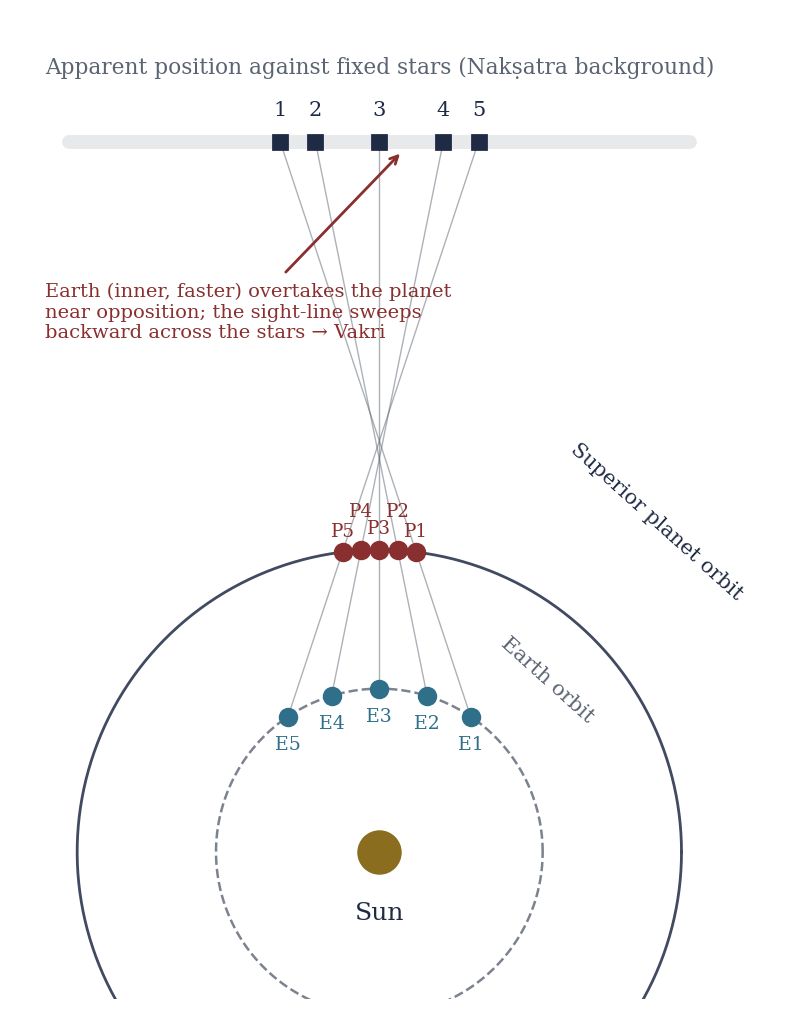
Figure 1. Geometry of apparent retrograde motion for a superior planet. As the inner, faster Earth (E1–E5) overtakes the planet (P1–P5) near opposition, the Earth–planet sight-line sweeps backward across the fixed-star background (positions 1–5), producing vakri motion.
2.2 Synodic configuration and timing
Retrograde episodes are governed by the synodic period S, the mean interval between successive identical Sun–Earth–planet configurations. For a superior planet of sidereal period P (with Earth's period P⊕), 1/S = 1/P⊕ − 1/P; for an inferior planet, 1/S = 1/P − 1/P⊕. Superior planets (Mars, Jupiter, Saturn) turn retrograde around opposition, when the Earth passes between the Sun and the planet; inferior planets (Mercury, Venus) turn retrograde around inferior conjunction. The Sun and Moon never retrograde. The mean lunar nodes (Rāhu and Ketu) move retrograde continuously, completing a cycle in ≈ 18.6 years. Table 2 summarizes the timing.
| Graha | Config. of retro | Synodic period (d) | Retro duration (d) | Retro / cycle |
|---|---|---|---|---|
| Budha (Mercury) | Inferior conj. | ≈ 116 | ≈ 21–24 | ≈ 3×/yr |
| Śukra (Venus) | Inferior conj. | ≈ 584 | ≈ 40–43 | once/cycle |
| Maṅgala (Mars) | Opposition | ≈ 780 | ≈ 60–80 | once/cycle |
| Guru (Jupiter) | Opposition | ≈ 399 | ≈ 120–123 | once/cycle |
| Śani (Saturn) | Opposition | ≈ 378 | ≈ 135–140 | once/cycle |
| Rāhu / Ketu | Mean nodes | — | always | continuous |
Table 2. Approximate synodic and retrograde parameters of the classical grahas. Durations vary with orbital eccentricity and the planet's ecliptic latitude at the episode.
2.3 Stations and the retrograde arc
Figure 2 shows λ(t) for a superior planet computed under a coplanar circular-orbit model centred on opposition. The curve rises (prograde), flattens at the first station S₁ where λ̇ = 0, decreases through the retrograde arc (λ̇ < 0), flattens again at the second station S₂, and resumes its rise. The two stations are the roots of λ̇(t) = 0 bounding the interval on which the planet is vakri. This condition is what an implementation must detect; it is exact and frame-defined, independent of any interpretive commitment.
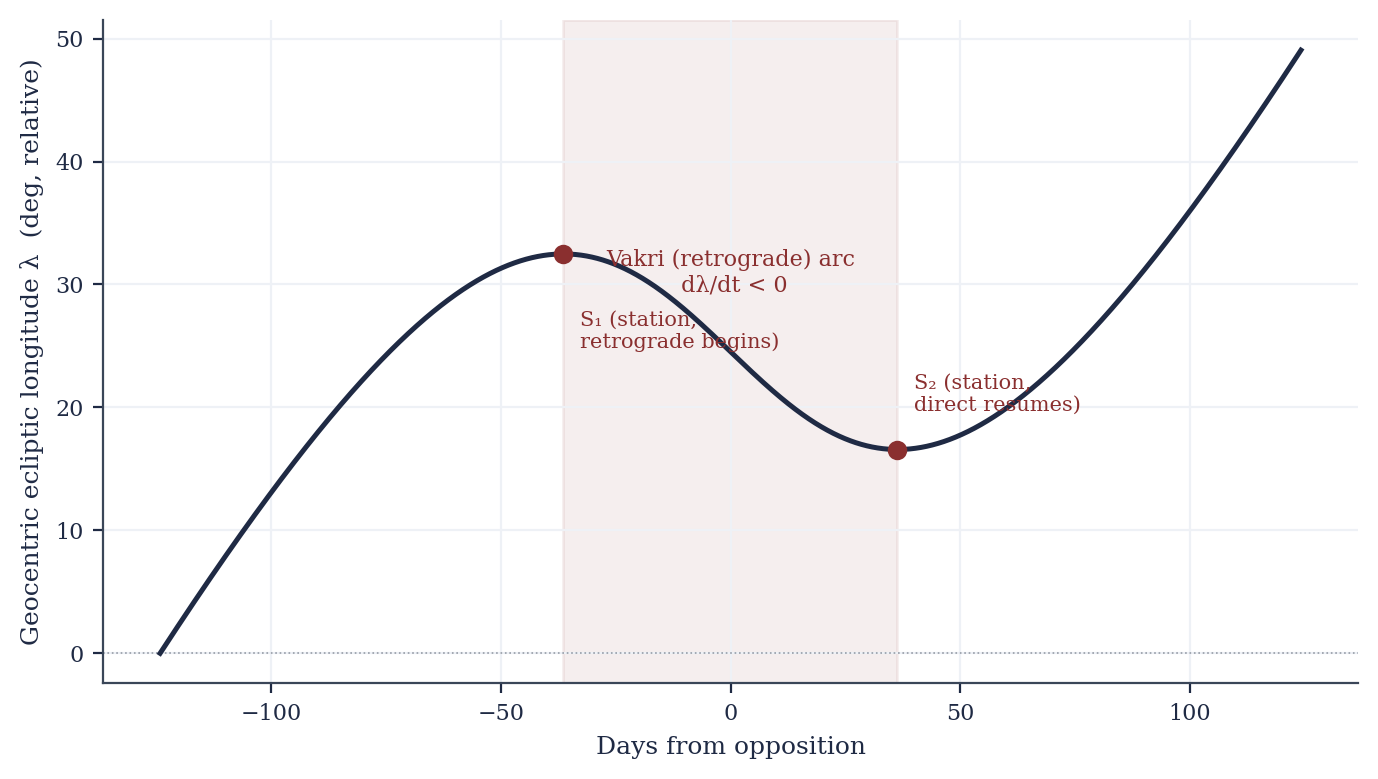
Figure 2. Geocentric ecliptic longitude λ(t) of a superior (Mars-like) planet across an opposition, coplanar circular-orbit model. The shaded arc, bounded by the stations S₁ and S₂ (λ̇ = 0), is the vakri interval.
3. The Classical Treatment of Vakra Gati
3.1 The eight-fold gati taxonomy
Parāśara and later authorities classify a planet's motion into eight states (aṣṭa-gati), ranging from deep retrograde to very swift direct motion. Table 1 states these together with their kinematic characterization in terms of λ̇. The taxonomy is a qualitative discretization of a continuous quantity (the geocentric rate) and is the classical counterpart of the velocity profile in Figure 2.
| Gati (Sanskrit) | Sense | Kinematic characterization (geocentric ecliptic rate λ̇) |
|---|---|---|
| Vakra | Retrograde | λ̇ < 0; apparent backward motion (deep, near opposition / inferior conjunction) |
| Anuvakra | Retro into prior sign | Retrograde motion that carries the planet back across a rāśi boundary |
| Vikala | Stationary | λ̇ ≈ 0; a station (Sₙ), the instantaneous turning point |
| Mandatara | Very slow direct | 0 < λ̇ ≪ mean; just after a direct station |
| Manda | Slow direct | λ̇ below the planet's mean daily motion |
| Sama | Mean motion | λ̇ ≈ mean daily motion |
| Cara | Swift direct | λ̇ above mean daily motion |
| Aticara | Very swift direct | λ̇ ≫ mean; maximal prograde speed |
Table 1. The eight-fold gati taxonomy mapped to the geocentric ecliptic rate λ̇. Qualitative thresholds are relative to the planet's mean daily motion; virūpa allotments for a categorical scheme vary across texts and are therefore not fixed here.
3.2 Ceṣṭā-bala within ṣaḍbala
The ṣaḍbala (six-fold strength) framework aggregates six sources of planetary strength: sthāna-bala (positional), dig-bala (directional), kāla-bala (temporal), ceṣṭā-bala (motional), naisargika-bala (natural), and dṛk-bala (aspectual). Strength is measured in virūpa, with 60 virūpa = 1 rūpa.
Ceṣṭā-bala is the component that rewards motional state, and it is precisely here that retrogression enters the strength calculus. In Parāśara's quantitative method it is derived from the ceṣṭā-kendra — an angle obtained from the planet's relationship to its śīghrocca (the fast apogee governing synodic motion). Reduced to the range [0°, 360°], the strength is
ceṣṭā-bala = κ ⁄ 3 for κ ≤ 180°, and (360 − κ) ⁄ 3 for κ > 180°,
where κ is the ceṣṭā-kendra in degrees. The function peaks at κ = 180° — the configuration of opposition and deepest retrograde — yielding the maximal 60 virūpa (Figure 3). This is the formal sense in which classical Jyotiṣa treats a deeply retrograde planet as motionally strongest. For the Sun and Moon, which do not retrograde, Parāśara substitutes ayana-bala and pakṣa-bala respectively in place of a synodic ceṣṭā term.
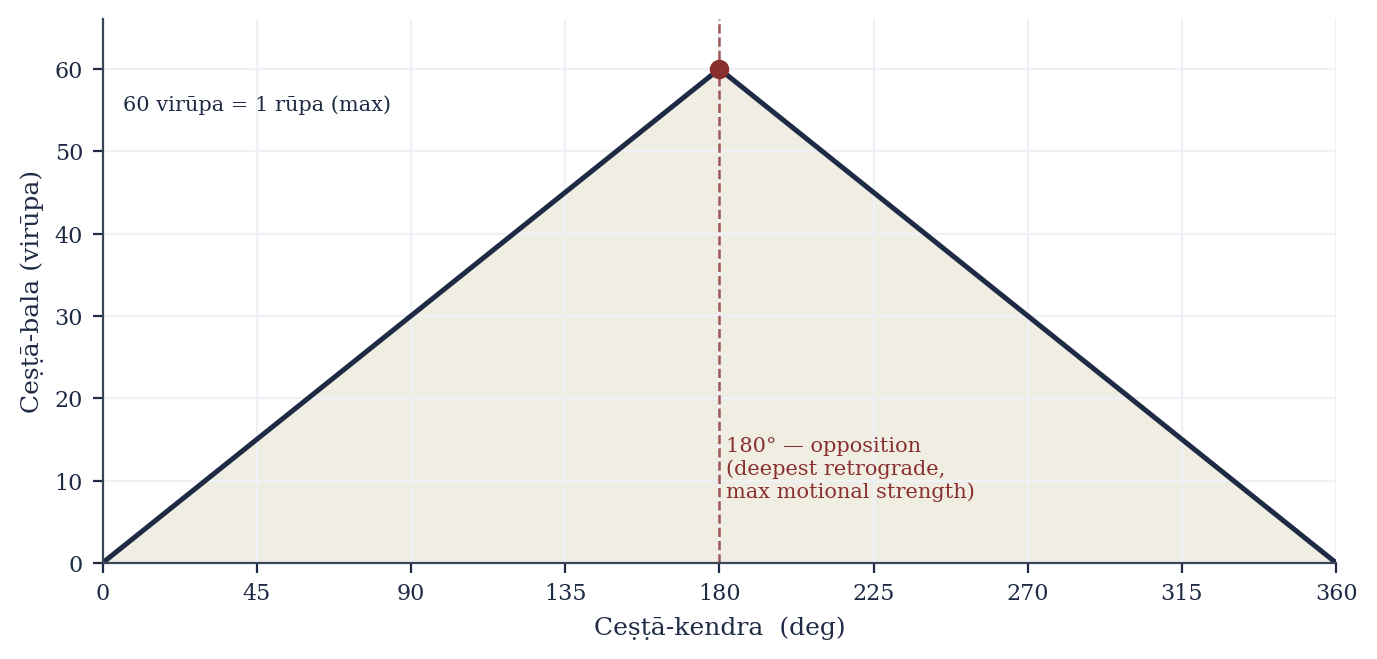
Figure 3. Ceṣṭā-bala as a function of the ceṣṭā-kendra κ under Parāśara's quantitative method. Motional strength is maximal (60 virūpa) at opposition / deepest retrograde (κ = 180°).
3.3 An interpretive śakti schema
Beyond the quantitative bala, the platform employs an interpretive schema that aligns three śaktis — icchā (will/desire), jñāna (knowledge), and kriyā (action) — with regimes of gati (Table 3). Under this schema a deeply vakri planet is read under the sign of icchā: an intensified, inward-turned desire attached to the planet's significations, whose concrete expression is modulated by the bhāva (house) it occupies and the nakṣatra in which it is placed. We present this mapping as an explicit, interpretive design choice of the system, not as a uniquely canonical classical doctrine; the classical corpus records several, sometimes divergent, interpretive stances (Section 3.4).
| Śakti | Associated gati regime | Interpretive signature used by the system |
|---|---|---|
| Icchā (will/desire) | Deep vakra (near opposition; high ceṣṭā-bala) | Intensified, inward-turned desire in the significations of the planet, its bhāva and nakṣatra |
| Jñāna (knowledge) | Vikala / near-stationary | Reflective, deliberative, 'held' quality; re-examination of the planet's themes |
| Kriyā (action) | Cara / aticara (swift direct) | Outward, executed, forward-moving expression of the planet's significations |
Table 3. The interpretive śakti schema adopted by the system, aligning icchā / jñāna / kriyā with gati regimes. Presented as a documented design choice, not an empirical claim.
3.4 The dignity debate
Classical authorities disagree on how retrogression interacts with dignity. One influential position holds that a retrograde planet in debilitation behaves as if exalted and vice versa (the nīcābhilāṣī / uccābhilāṣī principle); others, including strands of Sārāvalī and Phaladīpikā, weight the interaction differently. A faithful computational system must therefore treat the dignity–retrogression interaction as a parameterized, source-attributed rule rather than a single hard-coded verdict, so that the interpretive lineage of any given output remains explicit and auditable.
4. A Reproducible Computational Model
4.1 Retrograde-state detection
Given an ephemeris returning the apparent geocentric sidereal longitude λ(t) of a graha, retrograde state is determined by the sign of the longitudinal rate. In discrete form, for a small step h (e.g., one hour):
Algorithm 1 — Vakri state. (i) sample λ(t−h), λ(t+h); (ii) compute λ̇ ≈ [λ(t+h) − λ(t−h)] ⁄ 2h with 360°-wrap correction; (iii) return VAKRI if λ̇ < 0, MĀRGĪ if λ̇ > 0, VIKALA (station) if |λ̇| < ε. Stations are refined by bracketing the sign change of λ̇ and applying a root-finder (bisection or Brent) to λ̇(t) = 0.
4.2 Ceṣṭā-bala computation
Algorithm 2 — Ceṣṭā-bala. (i) obtain the ceṣṭā-kendra κ from the planet's synodic relation to its śīghrocca; (ii) reduce κ to [0°, 360°); (iii) return κ⁄3 if κ ≤ 180°, else (360 − κ)⁄3, in virūpa. The result feeds the ṣaḍbala aggregate. Because both κ and the reduction are deterministic functions of ephemeris quantities, the output is exactly reproducible and can be diffed against a reference ṣaḍbala implementation.
4.3 Gati classification and śakti mapping
The continuous rate λ̇ from Algorithm 1, normalized by the planet's mean daily motion, is discretized into the eight gati of Table 1 by threshold; the resulting gati is then mapped to a dominant śakti via Table 3. This yields, for any planet at any epoch, a triple ⟨vakri-state, ceṣṭā-bala, dominant-śakti⟩ that downstream interpretation consumes.
4.4 Worked example
Consider a natal Saturn whose ephemeris sampling yields λ̇ < 0 with a ceṣṭā-kendra near 180°. Algorithm 1 returns VAKRI; Algorithm 2 returns a ceṣṭā-bala approaching 60 virūpa; the gati classifier returns deep vakra, mapped to the icchā regime. The interpretive layer then reads this Saturn as motionally strong with an intensified, inward-turned expression of its significations, refined by the house and nakṣatra it occupies and by the dignity rule selected in Section 3.4 — with every step attributable to a documented source.
5. Operationalization in a Multi-Agent System
These primitives are embedded within a knowledge-grounded, multi-agent question-answering platform whose broader architecture — a semantic router dispatching across specialized agents grounded in classical texts — is described in a companion paper. For present purposes, the relevant points are three. First, vakri-state and ceṣṭā-bala are computed deterministically by a Jyotiṣa engine and supplied to agents as structured evidence, so that motional strength is never hallucinated by a language model. Second, queries whose correct answer depends on retrogression are routed to agents that explicitly consult this evidence. Third, interpretive claims are generated under retrieval grounding with source attribution, and are constrained by guardrails that keep motional-strength statements consistent with the computed ṣaḍbala. The astronomy is thus computed, not learned, and the interpretation is grounded, not free-form.
6. Evaluation Protocol
Because the substantive claims of this work are computational, the evaluation targets computation. The astronomical layer admits an objective gold standard: agreement of the computed vakri-state and station timings against an independent ephemeris (e.g., Swiss Ephemeris) over a multi-decade span for all five tāra grahas. The strength layer admits a second objective check: agreement of computed ceṣṭā-bala against a reference ṣaḍbala implementation. The interpretive layer is assessed by expert audit of rule-faithfulness rather than by any measure of predictive accuracy. Table 4 states the protocol; measured values are reported from a production run and are marked pending here rather than asserted.
| Axis | Metric | Target / status |
|---|---|---|
| Astronomical correctness | Vakri-state agreement vs Swiss Ephemeris (per-day, 5 grahas, 50-yr span) | ≥ 99.9% [to be measured] |
| Station timing | Mean |Δt| of computed stations vs reference | < 6 h [to be measured] |
| Ceṣṭā-bala fidelity | Mean |Δ| virūpa vs reference ṣaḍbala implementation | < 1 virūpa [to be measured] |
| Rule faithfulness | Expert audit of gati→interpretation mappings | [to be measured] |
| Routing | Correct dispatch of vakri-sensitive queries to the engine | [to be measured] |
Table 4. Evaluation protocol. The astronomical and strength axes have objective gold standards; the interpretive axis is assessed for source-faithfulness, not predictive validity. Values marked pending are to be filled from a production run.
7. Discussion and Epistemological Positioning
We wish to be unambiguous about what is and is not claimed. The astronomy in Sections 2 and 4 is standard positional astronomy and is verifiable to arc-second precision. The strength computation in Sections 3 and 4 is a faithful operationalization of documented classical rules, and its correctness is defined relative to those rules and to reference implementations — not relative to any external outcome. Nothing in this paper constitutes a claim that retrograde planets exert measurable causal influence on human affairs, nor that astrological interpretation is empirically predictive. Those are questions this work neither tests nor asserts.
The contribution is instead one of computational modeling and knowledge engineering: taking a construct that software usually flattens to a boolean, restoring its astronomical content and its classical quantitative machinery, and making the whole pipeline reproducible and auditable. This framing is also the ethically responsible one for a consumer-facing system: outputs are presented as tradition-grounded interpretation with transparent provenance, not as scientific prediction, and users are not misled about the epistemic status of what they receive.
8. Conclusion
Retrograde motion is a frame-dependent appearance with a precise astronomical definition and a well-specified classical treatment through ceṣṭā-bala and the gati taxonomy. We have formalized both, given reproducible algorithms that compute vakri-state and motional strength from an ephemeris, related them to an explicit interpretive schema, and situated them within a grounded multi-agent system — while drawing a clear line between the computational claims we make and the empirical claims we do not. Treating vakri as a first-class computational object, rather than a boolean flag, is what allows an automated system to reason about it with the depth the tradition actually specifies.
References
Duffett-Smith, P. (1988). Practical astronomy with your calculator (3rd ed.). Cambridge University Press.
Kalyāṇavarma. (1983). Sārāvalī (V. Subrahmanya Sastri, Trans.). Ranjan Publications. (Original composed c. 8th century CE).
Karttunen, H., Kröger, P., Oja, H., Poutanen, M., & Donner, K. J. (2017). Fundamental astronomy (6th ed.). Springer.
Koch, D., & Treindl, A. (2021). Swiss Ephemeris [Computer software]. Astrodienst AG.
Lewis, P., Perez, E., Piktus, A., Petroni, F., Karpukhin, V., Goyal, N., … Kiela, D. (2020). Retrieval-augmented generation for knowledge-intensive NLP tasks. Advances in Neural Information Processing Systems, 33, 9459–9474.
Mantreśvara. (1996). Phaladīpikā (G. S. Kapoor, Trans.). Ranjan Publications. (Original composed c. 13th–14th century CE).
Meeus, J. (1998). Astronomical algorithms (2nd ed.). Willmann-Bell.
Murray, C. D., & Dermott, S. F. (1999). Solar system dynamics. Cambridge University Press.
Parāśara. (1984). Bṛhat Parāśara Horā Śāstra (R. Santhanam, Trans.). Ranjan Publications. (Original composed c. early medieval period).
Raman, B. V. (1992). Graha and bhāva balas (7th ed.). UBS Publishers' Distributors.
Standish, E. M., & Williams, J. G. (2006). Orbital ephemerides of the Sun, Moon, and planets. In P. K. Seidelmann (Ed.), Explanatory supplement to the astronomical almanac. University Science Books.