
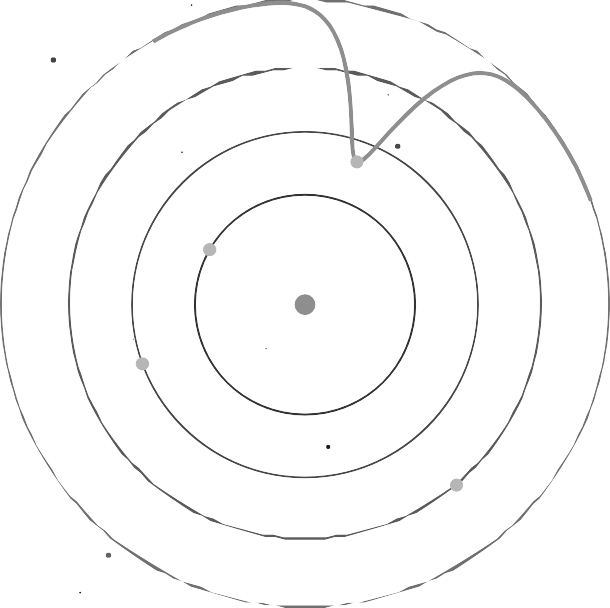
"Aplanet only appears to retrograde because of the relative motion between Earth and itself- the faster body overtaking the slower one, like a fast train sliding past a slow one until the slow train seems, for a moment, to roll backward. What looks like weakness is, in fact, a planet turning its power inward."
This is a field guide to that inward turn - what the classical texts ofJyotish actually say about the backward-walking planets, and how to read them without fear.
CONTENTS
What's Inside
Planetary Motion from a Geostationary Perspective 7
Why a planet appears to reverse 7
Inner planets vs. outer planets 7
Who can be Vakri - and who cannot 8
Three Powers of Motion: Ichha, Gyana & Kriya Shakti 9
How motion maps to the shaktis 9
Cheshta Bala and the Six-Fold Strength n
Cheshta Bala: the strength of retrograde motion 11
Oncauetion: combustion 12
Exalted or Debilitated? The Neechabhilashi Principle 13
The Neechabhilashi & Uchhabhilashi principle 13
General Effects of a Retrograde Planet 15
Retrograde and past-life karma 15
Thmaeturity age 15
Effects of Each Retrograde Planet 17
Retrograde Saturn - Vakri Shani 17
Retrograde Jupiter - Vakri Guru 17
Retrograde Mars - Vakri Mangal 17
Retrograde Mercury - Vakri Budha 18
Retrograde Venus - Vakri Shukra 18
Retrograde Planets in Each Sign 20
By element 20
Retrograde Planets in Each House 22
House by house 22
Conjunctions of Retrograde Planets 25
Multiple Retrograde Planets in a Chart 26
Remedies & Living With Retrograde Energy 28
Daily-alignment remedies by planet 28




CHAPTER 01
The Foundation
What Is Retrograde?
Retrograde is the most misunderstood word in astrology. Say it aloud and people brace for trouble - missed flights, broken phones, doomed romances. Yet in classical Vedic astrology the retrograde condition is not a warning label at all. It is one of the most powerful, most inward, and most personal states a planet can occupy.
In Sanskrit, a retrograde planet is called a Vakri Graha. Vakri means bent, curved, or turned back. It describes the planet's apparent path - not a flaw in its character. Classical texts use the word plainly, as a description of motion, and only then ask how that motion changes the way the planet delivers its results. Jyotish does not begin from the assumption that retrograde is bad.
The single most important fact to hold on to is this: no planet ever actually moves backward. Retrograde is an optical effect, a trick of viewing angle. And precisely because your birth chart is drawn from the Earth - not from the Sun - that apparent reversal is not something to be waved away. It carries real weight in the chart, even though, seen from the Sun, the planet never reversed at all.
THE ONE-LINE REFRAME
A retrograde planet is not a weakened planet. It is a planet that has turned its power inward and intensifi'ed it. Delayed, not denied. Deeper, not weaker.
Everything else in this guide - the astronomy, the strength doctrines, the effects by planet, sign and house - unfolds from that reframe. Once you understand why a planet appears to walk backward, the fear dissolves and the real usefulness begins.
CHAPTER 02
The Astronomy
Planetary Motion from a Geostationary Perspective
To read retrograde correctly you have to understand where you are standing. A Vedic birth chart is geocentric - it is cast from the vantage point of the Earth, as though the Earth were still and the heavens turned around it. This geostationary perspective is not a mistake; it is the whole point. Astrology describes the sky as a human being on Earth experiences it.
Why a planet appears to reverse
Every planet, including the Earth, orbits the Sun - always forward, never backward. But they travel at different speeds. Inner planets race; outer planets crawl. When a faster body overtakes a slower one, the slower one appears, from our moving platform, to slide backward against the fixed stars for a while before resuming its forward march.
The everyday version of this is the highway. As your car overtakes a slower car, that slower car seems, for a moment, to drift backward - even though it is still moving forward. Swap the cars for planets and you have retrograde motion exactly.
THE DETAIL THAT CHANGES EVERYTHING
At the very moment a planet turns retrograde, it is at its closest approach to Earth. It shines brighter in the night sky, and its influence on the chart is at its most concentrated. This physical fact is the astronomical root of the strength that classicalJyotish assigns to retrograde planets.
Inner planets vs. outer planets
The two inner planets, Mercury and Venus, sit inside Earth's orbit and never stray far from the Sun in our sky. They appear to retrograde when they swing between the Earth and the Sun, looping back through the patch of sky they had just crossed. The outer planets - Mars, Jupiter and Saturn - appear to retrograde when the faster Earth overtakes them on the inside track.
Who can be Vakri - and who cannot
Five of the seven classical grahas can become retrograde. The two luminaries never do, and the two lunar nodes are always retrograde. This is why the Panchang - the Hindu almanac - is built on the Sun and Moon: they are the steady, unwavering lights.
| Graha | Retrograde behaviour | Rough frequency | ||
| Mercury (Budha) | Periodic | 3-4 times a year | ||
| Venus (Shukra) | Periodic | Once every -18-19 months | ||
| Mars (Mangal) | Periodic | Once every -2 years | ||
| Jupiter (Guru) | Periodic | -4 months each year | ||
| Saturn (Shani) | Periodic | -4.5 months each year | ||
| Rahu&Ketu | Always retrograde | Constant (their nature) |
| Sun&Moon | Never retrograde |
Because Rahu and Ketu are always retrograde, their backward motion is part of their permanent character. It is not a temporary state that adds motional strength the way a true planet turning Vakri does - an important distinction we return to later.
CHAPTER 03
The Philosophy
Three Powers of Motion: Ichha, Gyana & Kriya Shakti
Behind the visible movement of the planets, classical thought places three fundamental powers - three shaktis - that drive all motion, cosmic and human alike. Understanding them turns retrograde from a mechanical curiosity into a meaningful state of being.
The three shaktis
Ichha Shakti - the power of will and desire. The first spark, the impulse that says ''I want."Nothing moves without it.
Gyana Shakti - the power of knowledge and understanding. The clarity that says ''I know. "Desire refined into direction.
Kriya Shakti - the power of action. The force that says ''I do."Understanding made real in the world.
In the natural order, these flow in sequence: desire gives rise to knowledge, and knowledge gives rise to action. Will becomes wisdom becomes work.
How motion maps to the shaktis
A planet in direct motion is heavy on Kriya Shakti. It faces forward and outward; it acts, produces, expresses. Its energy pours straight into the world.
A planet in retrograde motion pulls back toward Ichha and Gyana. It stops the doing long enough to re-examine what it truly wants and what it truly understands, before it acts again. This is the philosophical reason a Vakri planet so consistently behaves like unfinished business demanding a rethink. It is not stuck. It is re-choosing.
Hold these three powers in mind as you read the chapters ahead. Every effect of a retrograde planet - the inward turn, the delay, the recurring lesson - is really the sound ofKriya yielding the floor back to Ichha and Gyana.
DIRECT VS. RETROGRADE, IN A SENTENCE
Direct motion is instant expression. Retrograde is reflection before expression - the planet pauses, reviews, and only then moves. This is why its gifts arrive with depth rather than speed.
CHAPTER 04
The Hidden Strength
Cheshta Bala and the Six-Fold Strength
If a retrograde planet is genuinely powerful, that power ought to be measurable - and inJyotish it is. The classical system that weighs a planet's total strength is called Shadbala, the six-fold strength. It assesses each planet across six independent sources of power.
The six strengths (Shadbala)
Sthana Bala - positional strength (dignity, exaltation, own sign).
Dig Bala - directional strength (the right planet in the right quadrant).
Kala Bala - temporal strength (day/night, lunar phase, year and hour).
Cheshta Bala - motional strength, drawn especially from retrograde motion.
N aisargika Bala - natural, inherent strength, fixed for each planet.
Drik Bala - aspectual strength, from the glances of other planets.
Cheshta Bala: the strength of retrograde motion
Cheshta means effort or striving. Cheshta Bala measures a planet's motional vigour
- and a retrograde planet, physically closest to Earth and appearing to strive against the ordinary current, is credited with high Cheshta Bala. Slow-moving planets and planets at a station (pausing to turn) also gain heightened motional strength.
This is the technical basis for the claim that a Vakri planet is strong. But note the careful wording of the classics: Cheshta Bala measures strength, not benefit. A planet may be motionally powerful and still deliver difficult results if the rest of the chart is difficult. Strength is the engine; the chart is the road.
One caution: combustion
THE STATION: PEAK INTENSITY
A planet that turned retrograde - or turned direct - on or very near your birthday is at its station, its most concentrated point. Even half a degree of daily motion is treated as stationary. These placements often outweigh a planet that has been retrograde for weeks. Always check the station date before summarising a retrograde planet.
A retrograde planet drawing close to the Sun may become combust (Asta) - burnt by the Sun's glare and stripped of visible strength. Retrograde strength and combustion weakness can exist in the same planet at the same time. When they do, weigh both; do not let one cancel your reading of the other automatically.
CHAPTER 05
The Classical Debate
Exalted or Debilitated? The Neechabhilashi Principle
Honest astrology admits where the masters disagreed - and on retrograde planets, they did. Rather than a single verdict, the classics hand us a spectrum of views. Knowing them keeps you from the trap of one-line judgements.
What the classical authorities say
Brihat Parashara Hora Shastra folds retrogression into Cheshta Bala - treating it as pure motional strength within Shadbala.
Saravali (Kalyanavarma): retrograde benefics become powerful, even yielding Raja-yoga-like results; retrograde malefics can bring restless, aimless, wandering effects.
Phaladeepika (Mantreshwara): a retrograde planet behaves like an exalted one - even when placed in an enemy or debilitation sign - and, when clear of the Dusthanas, gives prominent results.
The Neechabhilashi & Uchhabhilashi principle
A widely-used practical refinement reads a planet by the direction it is travelling relative to its own exaltation and debilitation points:
Uchhabhilashi - a planet moving toward its exaltation gains beneficence.
Neechabhilashi - a planet that has crossed its exaltation and is heading toward
debilitation sheds some of its power to do good.
Combined with the well-known maxim that a debilitated planet, if retrograde, can act like an exalted one - and an exalted planet retrograde like a somewhat debilitated one - this gives a nuanced, directional way to read any Vakri planet, instead of a flat label. Always cross-check with Neecha Bhanga (the cancellation of debilitation) before concluding.
THE RULE TO CARRY EVERYWHERE
Sign dignity and retrograde status are independent factors. Retrograde adds motional strength; it does not change the quality of the sign. A retrograde planet may be strong by one measure and awkward by another - you always weigh dignity, retrograde, house, lordship and aspect together, never in isolation.
CHAPTER 06
The Signature
General Effects of a Retrograde Planet
Whatever the planet, whatever the chart, retrograde placements share a recognisable signature. Learn it once and you can feel the retrograde quality in any planet before you even name its department oflife.
The four hallmarks
Energy turns inward. The planet's themes are processed internally- often long before they appear in your outer life. AV akri planet lives first as an inner experience, then as an outer one.
Delayed, not denied. Results arrive later - frequently after the planet's maturity age - but usually with greater depth and staying power than a quick, surface result would have had.
Recurring lessons. The same theme returns until it is mastered. Many practitioners read this as unfinished karma from a past life in that planet's domain.
Unconventional expression. The planet delivers its promise through indirect, non-linear or unusual pathways. It rarely does things the ordinary way.
Retrograde and past-life karma
Across traditions, the unifying reading of a natal retrograde planet is unfinished business carried into this life. The planet marks an area where you arrived already advanced - with past-life mastery or a pending debt - and where recurring situations will keep arriving until your response changes. This is the non-fatalistic use of retrograde karma: not a sentence, but a map of where growth is waiting. Once the response changes, the results change.
The maturity age
Each planet has a maturity age - the point after which its lessons tend to consolidate into gifts. For a retrograde planet this matters doubly, because its hardest lessons so often transform into its greatest strengths after this age.
| Planet |
Maturity age |
Retrograde gift after maturity |
|---|---|---|
| Jupiter | ~16 | Self-earned wisdom and philosophy |
| Venus | ~25 | A deep, original sense oflove and value |
| Mars | ~28 | Strategic, disciplined use of force |
| Mercury | ~32 | Penetrating, layered analytical power |
| Saturn | ~36 | Durable structures built to last |
THE SINGLE WORST THING YOU CAN DO
Force speed. Rushing a retrograde planet backfi"res every time. Its themes reward depth, revision and patience. If Saturn is Vakrz� do not expect career shortcuts; if Venus is Vakrz� do not force a relationship to move faster than its truth.
CHAPTER 07
The Five Grahas
Effects of Each Retrograde Planet
The retrograde signature is the same; the department of life is not. Here is how each of the five true planets expresses the inward turn - followed by a note on the ever-retrograde nodes.
Retrograde Saturn -Vakri Shani
Saturn rules discipline, structure, time, duty, karma and long commitment. Retrograde, it carries the heaviest karmic reprocessing of the five. There is a backlog to clear, and the clearing is done through patience and repeated effort. Structures - careers, systems, obligations - get built, questioned and rebuilt. The lesson is that there are no shortcuts; the gift is that what you finally build lasts. Past-life theme: responsibility once shouldered but not fully internalised.
Retrograde Jupiter - Vakri Guru
Jupiter rules wisdom, expansion, fortune, faith and children. Retrograde, its expansive energy turns inward, producing wisdom earned through lived experience rather than inherited belief. Such a person may reject conventional dogma and build a deeply personal philosophy. External growth and recognition can lag even while inner expansion is profound. The key is to apply what is learned - embodied practice is what turns knowledge into wisdom. Past-life theme: knowledge gained, wisdom not yet embodied.
Retrograde Mars -Vakri Mangal
Mars rules drive, courage, action, competition and anger. Retrograde, this fire is internalised. Action can be slow to start, and anger may be suppressed before surfacing unexpectedly - yet the same person is often a formidable strategist, planning the whole campaign before making a move. The discipline is learning
when to push and when to hold. Channel the energy into steady, physical, repeatable effort. Past-life theme: unresolved anger or the misuse of power.
Retrograde Mercury - Vakri Budha
Mercury rules speech, logic, writing, trade and learning. Retrograde, it produces a layered, revising mind that reviews details closely and catches what others miss - superb for research, editing and deep analysis. The cost is a tendency to over-analyse or hesitate in communication, and decisions can come slowly. Commit to clarity and fact-checking; let yourself revise, but choose a point to ship. Past-life theme: unfinished intellectual or communication karma.
Retrograde Venus -Vakri Shukra
Venus rules love, art, beauty, comfort and self-worth. Retrograde, all of these are re-examined rather than accepted at face value. Love may not come easily, or may arrive unconventionally; old relationships return, and old wounds around self-worth resurface, before a final, values-aligned commitment. The gift is a deep, original aesthetic and the capacity to define love on one's own terms. Keep boundaries and values clear. Past-life theme: unresolved relationship or self-worth patterns.
Rahu & Ketu - always Vakri
The lunar nodes are always retrograde, so their backward motion is their nature rather than a special state. Rahu amplifies worldly desire, obsession and unconventional, boundary-crossing ambition; Ketu turns toward detachment, spirituality and past-life mastery - an area you are karmically "done" with yet instinctively skilled at. Because their retrograde is constant, always read the nodes through their sign, house, dispositor and dasha, not through their (permanent) retrograde status.
BENEFICS VS. MALEFICS - A LEAN, NOT A LAW
Classical texts note that retrograde benefics CTupiter, Venus, Mercury) often become notably powerful, while retrograde malefics (Saturn, Mars) can bring more restless, obstacle-heavy energy that resolves through discipline. Treat this as a tendency to test against the chart - never as an automatic verdict.
CHAPTER 08
Across the Rashis
Retrograde Planets in Each Sign
Where a planet's house tells you which area of life is affected, its sign (Rashi) tells you the flavour and dignity of that energy. The governing rule, from the previous chapter, bears repeating: retrograde adds motional strength but does not change the quality of the sign. You read the two together.
The dignity anchors
Because all five retrograde planets pass through all twelve signs, the most useful thing to memorise is where each planet is exalted, debilitated, or at home. When a Vakri planet lands on one of these points, dignity and motional strength either reinforce each other or pull against each other - and the Neechabhilashi principle tells you which way the tension resolves.
| Planet | Exaltation | Debilitation | Own signs |
|---|---|---|---|
| Mercury | Virgo | Pisces | Gemini, Virgo |
| Venus | Pisces | Virgo | Taurus, Libra |
| Mars | Capricorn | Cancer | Aries, Scorpio |
| Jupiter | Cancer | Capricorn | Sagittarius, Pisces |
| Saturn | Libra | Aries | Capricorn, Aquarius |
By element
Fire - Aries, Leo, Sagittarius {Agni)
Retrograde here banks the outward fire into a slow-burning inner intensity - strong will (Ichha Shakti) that reviews itself before acting. Mars in Aries (own sign) is potent; Saturn retrograde in Aries (debilitation) is the classic "high energy, hard expression" case the Neechabhilashi principle helps decode.
Earth - Taurus, Virgo, Capricorn (Prithvi)
Retrograde deepens patience, method and material focus but adds revision and delay to practical matters. Mercury retrograde in Virgo (exaltation) is exceptionally analytical; Venus, already debilitated in Virgo, retrograde is a textbook case for weighing dignity against motional strength.
Air - Gemini, Libra, Aquarius (Vayu)
Retrograde turns communication and relationship energy inward - more reflection, less broadcasting. Saturn retrograde in Libra (exaltation) is a standout: dignified, disciplined and motionally strong at once. Mercury in Gemini or Aquarius loops thoughtfully before it speaks.
Water - Cancer, Scorpio, Pisces Uala)
Retrograde intensifies emotion, intuition and subconscious processing. Jupiter retrograde in Cancer (exaltation) is deeply wise and inward; Mars retrograde in Cancer (debilitation) carries strong energy behind a tender, indirect expression that needs conscious channelling.
CHAPTER 09
Through the Bhavas
Retrograde Planets in Each House
The house a Vakri planet occupies decides which area of life receives the inward turn, the delay and the recurring lesson. Three principles frame every house reading.
Three framing principles
Kendras & Trikonas are strongest. In houses 1, 4, 7, 10 (Kendra) and 1, 5, 9 (Trikona), the retrograde planet's concentrated energy has a solid house to work through - its themes become pronounced, repeating life motifs.
Dusthanas are complex. In houses 6, 8, 12 the house already carries difficulty, hidden matters or loss; a retrograde planet tends to cycle through those themes repeatedly before resolving them. A pattern of recurrence, not a prophecy of harm.
The previous-house doctrine. A classical rule holds that a retrograde planet also exerts influence from the house behind it. Views differ - many find the planet mainly delivers where it sits, especially past 15°. Use it as one input, not gospel. Also weigh the house the planet rules, not just the one it occupies.
House by house
- Self, identity, body
Identity and confidence are re-examined; introspection and self-doubt early, then a profound, individual self-understanding later. Outer success can lag inner growth.
- Wealth, speech, family
Recurring themes around money, values and family speech; income often irregular or self-built through revision; a thoughtful, sometimes hesitant manner of speaking.
- Courage, siblings, communication
Skill and communication develop in layers - hesitation early, real mastery later through writing, learning or practice; sibling ties may need repeated work.
- Home, mother, emotional base
Introspection about roots and emotional security; possible dissatisfaction with home or matters of the mother, resolving into a redefined inner peace.
- Creativity, children, intelligence
Creativity and romance processed inwardly and blooming later; a retrograde benefic here (especially Jupiter) can quietly elevate the whole chart.
- Service, health, obstacles
A Dusthana; work, health and rivalry themes recur, often forging a person who repeatedly overcomes obstacles - but resolution takes cycles.
- Marriage, partnership
Relationships approached thoughtfully; commitment tends to come late but meaningfully, sometimes after reconnecting with a past partner. Peaks in that planet's dasha.
- Transformation, longevity, secrets
A Dusthana; intensifies interest in the occult, psychology and research, with recurring transformations. One of the more demanding placements - read whole.
- Fortune, dharma, higher wisdom
Beliefs and ethics questioned and rebuilt into a personal philosophy; fortune may be delayed but becomes deeply self-earned. Strong for genuine wisdom.
- Career, status, action
Career involves repeated starts, retracing steps, or returning to a field after leaving; recognition may be delayed, but the authority earned this way is durable.
- Gains, networks, aspirations
Income streams, friendships and long-term goals develop in cycles - reworked plans and gains that arrive after persistence rather than quickly.
- Loss, spirituality, foreign lands, moksha
A Dusthana; turns strongly toward private effort, foreign links, spirituality and the subconscious - excellent for inner and meditative work.
CHAPTER 10
Yuti
Conjunctions of Retrograde Planets
Retrograde planets rarely act alone. When a Vakri planet joins another in the same sign and house - a conjunction, or Yuti - it lends an inward, revisiting, intensified quality to the blend.
How the blend behaves
The retrograde planet colours the conjunction. Its themes are processed internally and tend to recur; a direct planet joined to a retrograde one finds its own expression pulled into a cycle of review before it can act cleanly.
Benefic + retrograde benefic (e.g. Jupiter-Venus) deepens the positive significations - rich but delayed value, wisdom or creativity that matures with time.
Malefic + retrograde malefic (e.g. Mars-Saturn) intensifies pressure and can bring recurring friction that resolves only through discipline. Powerful, but demanding.
Yoga reshaping. A retrograde benefic bridging a Kendra and a T rikona, or a retrograde malefic completing a hemming (Paap-Kartari) pattern, can change the entire complexion of a chart.
THE METHOD - LAYER, DON'T AVERAGE
Read each planet's dignity and retrograde status separately first, then read the blend. Never average two planets into a single vague impression. The conjunction's house and the planets' lordships still decide whether the intensified energy builds or blocks. And watch for combustion: a retrograde planet very close to the Sun may be burnt even as it is motionally strong.
CHAPTER 11
The Karmic Weave
Multiple Retrograde Planets in a Chart
Having several Vakri Grahas is more common than people fear, and it is not a red flag. It signals a more layered karmic path - and, read correctly, an unusually deep one.
What multiple retrogrades indicate
Stronger review cycles. Life includes more phases of revisiting and reworking before things settle. Early years can feel slower; mastery and stability tend to arrive later.
Back-and-forth karma. Similar situations recur across several departments oflife at once - a mechanism, in the karmic reading, for resolving unfinished matters from past lives.
Depth over speed, in multiple areas. Each retrograde planet adds introspection to its own domain, so the person often develops rare depth in several life areas rather than quick, surface success.
How to read it correctly
Judge each retrograde planet on its own first - its sign, dignity, house and lordship.
Then read the connections - conjunctions, mutual aspects, and where the dashas overlap.
Time it through the dasha system. A retrograde planet can stay quiet for years, then take centre stage in its Mahadasha, bringing its unfinished themes forward for resolution.
Two or more well-placed benefic retrogrades can make a chart notably strong - deep, self-earned success after disciplined correction. Several malefic retrogrades ask for more patience but can forge exceptional resilience.
THE ATMAKARAKA NUANCE
If the Atmakaraka - the planet at the highest degree, the "soul signifkator" - is itself retrograde, the karmic reading intensifies. The soul's core unfinished desire is felt as especially deep and long-carried, and that planet's lessons become central to the life's purpose.
CHAPTER 12
Working With It
Remedies & Living With Retrograde Energy
A retrograde planet is not something to fix. It is something to work with. The classical remedies are less about neutralising a planet and more about aligning your daily life with the lesson it is asking you to learn.
Four principles of practice
Don't force speed. The retrograde planet's themes reward depth and patience. Forcing them is the one reliable way to make them harder.
Mind the maturity age. Plan major moves in a retrograde planet's domain for after its maturity age, when its hardest lessons turn into its greatest gifts.
Honour the recurring theme. When the same situation returns, treat it as an invitation to change your response, not as bad luck repeating.
Read the whole chart. Retrograde alone never tells the full story; sign, house, lordship, aspect and dasha shape the outcome together.
Daily-alignment remedies by planet
In Vedic practice, a remedy is a form of daily alignment that works through consistency. Alongside mantra, charitable giving (daan) on the planet's weekday, fasting or seva - best chosen with chart-specific guidance - the core alignment for each planet is simple:
Budha (Mercury): practise clear communication and fact-checking; finish what you draft.
Shukra (Venus): make value-based choices in money and relationships; keep boundaries clean.
Mangal (Mars): channel energy into disciplined, physical, repeatable action.
Guru Qupiter): study- and then apply what you study; embody the wisdom.
Shani (Saturn): honour time, duty and long-term commitment; expect no shortcuts.
Many practitioners also associate retrograde planets with past-life karmic clearing, and hold that charitable acts tied to the planet help lighten its karmic load. Whatever the outer ritual, the inner principle is constant: meet the planet where it lives - on the inside - and let the results follow.
IN CLOSING
Delayed, Not Denied
A retrograde planet is not a curse in your chart or a bug in the sky. It is a planet that has turned its power inward - asking you to slow down, look back, understand, and finally master the part oflife it governs. It is Kriya yielding to Ichha and Gyana; it is will and knowledge gathering themselves before action. It is closest to the Earth, brightest in the sky, and strongest in Cheshta Bala precisely when it appears, to the casual eye, to be walking backward.
The classics disagreed on the details, and that is a gift: it means retrograde was never meant to be read with a single word. It is read whole - by sign and house, by lordship and aspect, by conjunction and dasha, by dignity and direction. Do that, and the fear falls away, and what remains is a map of exactly where your depth, your patience, and your greatest late-arriving gifts are waiting.
The backward-walking planets were never lost. They were only looking back
- so that you could learn to look inward.
SEE YOUR OWN CHART
RetroGrade reads retrograde planet in your chart - by sign, house, conjun_ction dasha - and explains e
one in plain language. No jargon. No fear.Just clarity.
retrograde.co.in
RETROGRADE
Al-Powered Vedic Astrology